
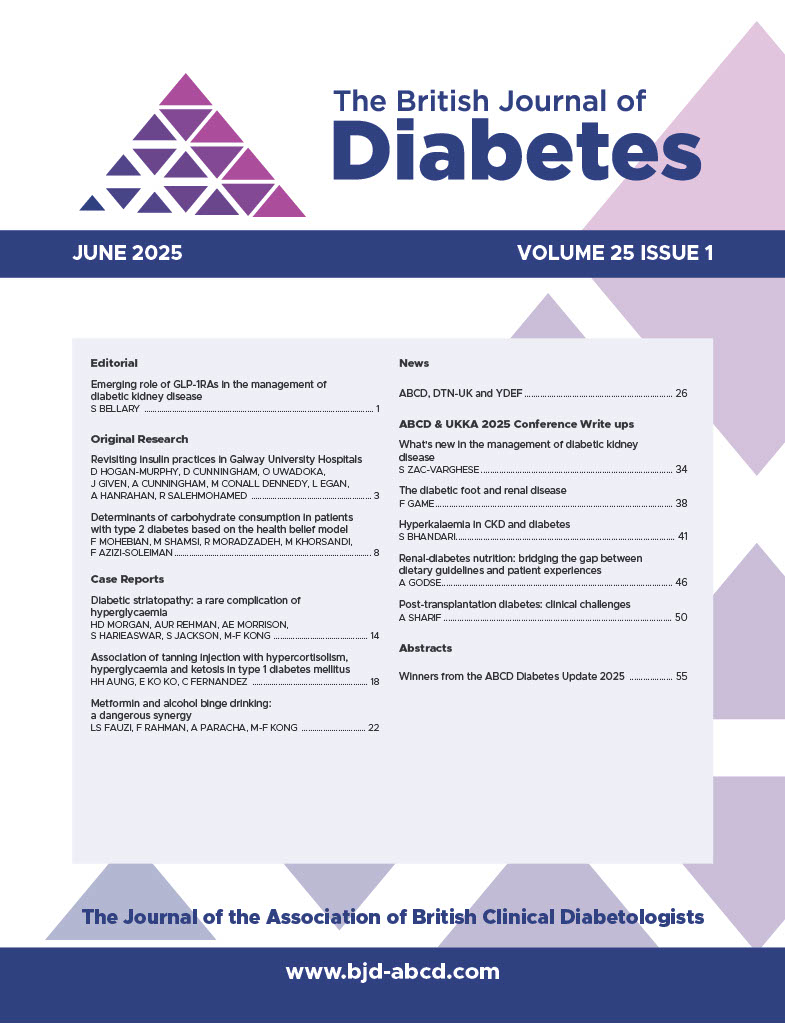
Metformin and alcohol binge drinking: a dangerous synergy
DOI:
https://doi.org/10.15277/bjd.2025.476Keywords:
alcoholic ketoacidosis, lactic acidosis, metformin toxicity, binge drinkingAbstract
Background: Alcoholic ketoacidosis (AKA) is an under- recognised presentation seen in chronic alcoholics with a recent history of binge drinking. Metformin- associated lactic acidosis (MALA) is a rare complication of biguanide treatment which is generally induced by overdose or reduced clearance. Both can present with a significant high anion gap metabolic acidosis and hyperlactataemia.
Case report: A 52-year-old man with a background history of chronic alcoholism and type 2 diabetes mellitus (T2DM) treated with metformin only (latest HbA1c 7% / 53 mmol/mol) presented to the hospital with vomiting. He was hypotensive and had acute kidney injury (AKI) stage 3. This presentation occurred after an episode of binge drinking 12 hours prior. He had had three similar episodes in the past, two episodes occurring within 24 hours of binge drinking. Venous blood gas measurement on presentation showed a pH of 6.934, lactate of 16 mmol/L and glucose of 21.7 mmol/L, and bedside ketones were 3.2 mmol/L. He was treated according to the hospital diabetic ketoacidosis (DKA) protocol.
Discussion: In the presence of a recurrent history of DKA in a patient with chronic alcoholism, AKA should be considered. The mechanism of AKA is complex and occurs in the setting of insulin deficiency and excess glucagon release. Excess ethanol metabolism favours the formation of beta-hydroxybutyrate ketoacid. Counter-regulatory hormones and volume depletion drive lipolysis and ketosis. Repeated episodes of binge drinking- induced renal impairment may have caused metformin accumulation, resulting in hyperlactataemia.
Conclusion: We should consider both AKA and MALA in binge drinkers who present with recurrent severe acidosis.
References
McGuire LC, Cruickshank AM, Munro PT. Alcoholic ketoacidosis. Emerg Med J 2006; 23: 417-20. https://doi.org/10.1136/emj.2004.017590
Wrenn KD, Slovis CM, Minion GE, Rutkowski R. The syndrome of alcoholic ketoacidosis. Am J Med 1991;91(2):119–28. https://doi.org/10.1016/0002-9343(91)90003-g
Halperin ML, Hammeke M, Josse RG, Jungas RL. Metabolic acidosis in the alcoholic: a pathophysiologic approach. Metabolism 1983; 32(3):308–15. https://doi.org/10.1016/0026-0495(83)90197-x
Umpierrez GE, Digirolamo M, Tuvlin JA, Isaacs SD, Bhoola SM, Kokko JP. Differences in metabolic and hormonal milieu in diabetic- and alcohol- induced ketoacidosis. J Crit Care 2000;15(2):52-9. https://doi.org/10.1053/jcrc.2000.7900
Møller N, Gjedsted J, Gormsen L, Fuglsang J, Djurhuus C. Effects of growth hormone on lipid metabolism in humans. Growth Horm IGF Res 2003;13:S18–21. Available from: https://www.sciencedirect.com/ science/article/pii/S1096637403000480 https://doi.org/10.1016/s1096-6374(03)00048-0
Debuyser A, Drews G, Henquin JC. Adrenaline inhibition of insulin release: role of the repolarization of the B cell membrane. Pflugers Arch 1991;419(2):131–7. https://doi.org/10.1007/BF00372998
Brady PS, Brady LJ. Regulation of carnitine palmitoyltransferase in vivo by glucagon and insulin. Biochem J 1989;258(3):677–82. https://doi.org/10.1042/bj2580677
Kreisberg RA. Lactate homeostasis and lactic acidosis. Ann Intern Med 1980;92(2 Pt 1):227–37. https://doi.org/10.7326/0003-4819-92-2-227
Inzucchi SE, Lipska KJ, Mayo H, Bailey CJ, McGuire DK. Metformin in patients with type 2 diabetes and kidney disease a systematic review. JAMA 2014;312(24):2668–75. https://doi.org/10.1001/jama.2014.15298
Protti A, Russo R, Tagliabue P, et al. Oxygen consumption is depressed in patients with lactic acidosis due to biguanide intoxication. Crit Care 2010;14(1):R22. https://doi.org/10.1186/cc8885
Wang DS, Kusuhara H, Kato Y, Jonker JW, Schinkel AH, Sugiyama Y. Involvement of organic cation transporter 1 in the lactic acidosis caused by metformin. Mol Pharmacol 2003;63(4):844-8. https:doi.org/10.1124/mol.63.4.844
Owen MR, Doran E, Halestrap AP. Evidence that metformin exerts its anti-diabetic effects through inhibition of complex 1 of the mitochondrial respiratory chain. Biochem J 2000;348(3):607-14. PMID:10839993. PMCID:PMC1221104
Published
Issue
Section
License
Copyright (c) 2025 British Journal of Diabetes

This work is licensed under a Creative Commons Attribution 4.0 International License.
Manuscripts published in the June 2024 edition and after in the BJD have been published in open access under a Creative Commons Attribution 4.0 International License and available at https://www.bjd-abcd.com. Prior year articles are available free of charge via our website.